
CO² Effect on Climate Change
Unprecedented in Earth’s History?
Climate change: evidence and causes
The present level of atmospheric CO2 concentration is almost certainly unprecedented in the past million years, during which time modern humans evolved and societies developed. The atmospheric CO2 concentration was however higher in Earth’s more distant past (many millions of years ago), at which time paleoclimatic and geological data indicate that temperatures and sea levels were also higher than they are today.
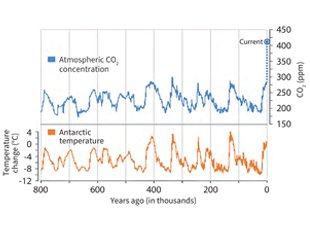
Figure 1. Data from ice cores have been used to reconstruct Antarctic temperatures and atmospheric CO2 concentrations over the past 800,000 years. Temperature is based on measurements of the isotopic content of water in the Dome C ice core. CO2 is measured in air trapped in ice and is a composite of the Dome C and Vostok ice core.
The current CO2 concentration (blue dot) is from atmospheric measurements. The cyclical pattern of temperature variations constitutes the ice age/ interglacial cycles. During these cycles, changes in CO2 concentrations (in blue) track closely with changes in temperature (in orange). As the record shows, the recent increase in atmospheric CO2 concentration is unprecedented in the past 800,000 years. Atmospheric CO2 concentration surpassed 400 ppm in 2016, and the average concentration in 2019 was more than 411 ppm.
Measurements of air in ice cores show that for the past 800,000 years up until the 20th century, the atmospheric CO2 concentration stayed within the range 170 to 300 parts per million (ppm), making the recent rapid rise to more than 400 ppm over 200 years particularly remarkable [figure 1]. During the glacial cycles of the past 800,000 years both CO2 and methane have acted as important amplifiers of the climate changes triggered by variations in Earth’s orbit around the Sun. As Earth warmed from the last ice age, temperature and CO2 started to rise at approximately the same time and continued to rise in tandem from about 18,000 to 11,000 years ago. Changes in ocean temperature, circulation, chemistry, and biology caused CO2 to be released to the atmosphere, which combined with other feedback to push Earth into an even warmer state.
For earlier geological times, CO2 concentrations and temperatures have been inferred from less direct methods. Those suggest that the concentration of CO2 last approached 400 ppm about 3 to 5 million years ago, a period when global average surface temperature is estimated to have been about 2 to 3.5°C higher than in the pre-industrial period.
At 50 million years ago, CO2 may have reached 1000 ppm, and global average temperature was probably about 10°C warmer than today. Under those conditions, Earth had little ice, and sea level was at least 60 metres higher than current levels.
The problem we have is that if you use definitive science the cause of CO² concentrations on temperature do not give these levels of changes, it has to be other factors.
If there were no greenhouse gases in the atmosphere, their insulation effect of preventing heat escaping from earth was removed, the temperature would fall, within about a degree or so, by about 33°C. That is a definitive scientific calculation we can do.
We can physically measure the insulation effect of concentrations of CO² in terms of the parts per million (ppm) and the temperature variation.
If you draw a graph of concentrations and temperature effect, as you would expect, the greater the concentration the greater the insulation effect but when you reached beyond a certain level, the effect will reduce and virtually peter out. Taking the analogy of blacking out glass panes to stop the sun rays getting through, any additional coats of paint would have a lesser effect.
The graph shows that between zero and 400 ppm, where we are now, there is a strong effect, but it begins to tail off until you get to 1,000 ppm when it virtually ceases and only increases very marginally. It should be noted that below 150 ppm plant life would not exist as CO² is a vital feedstock for plant growth, hence why the earth over the last decade is 15% greener.
50 million years ago the concentrations were at 1,000 ppm and beyond that even higher to over 2,000ppm to the dawn of the earth. Incidentally ice ages preceded changes in CO²!
The Stefan-Boltzmann formula is based on irrefutable physical science.
If you assumed the concentrations of CO² doubled from 400 ppm to 800 ppm then the formula calculation would say the temperature change would be 2,2% of the 33°C or 0,73°C, i.e. less than one degree!
So, we can conclude that simply observing CO² changes does not demonstrate cause and effect beyond that range from greenhouse gases.
Climate change is a very complex area we do not yet fully understand it. We can’t even explain why there is a seven-year solar cycle, it just happens, one of those known unknowns Donald Rumsfeld referred to.
Politicians or other commentators, like Grant Shapps, who assert the destruction of the planet through greenhouse gases, are promulgating the greatest delusion of mankind since it was thought the world was flat. The problem here though is, if we act on it, we will destroy ourselves by our own ignorant actions.
A simple question a journalist could ask of anyone stating the climate mantra is have you done the planetary heat equation and what did you assume to arrive at your assertion? You will find such people do not understand the second law of thermodynamics never mind climatology. I would love to ask Great Thunberg that one! Then perhaps suggest she did more school work on basic science. Rest easy, we can use all the US$ 100tr of dosh on better things.